





5 Common Causes of Tooth Sensitivity You Should Know
A patient comes in with sensitivity for three months. Been using sensitive toothpaste. It helped for a while but it’s back. The dentist looks at the gum line, runs one quick test, and finds a small area of recession the patient didn’t know was there.
That’s how most tooth sensitivity cases present at Elite Dental Studio in Kannur. The dental team here has diagnosed and treated sensitivity across thousands of patients since 2020.
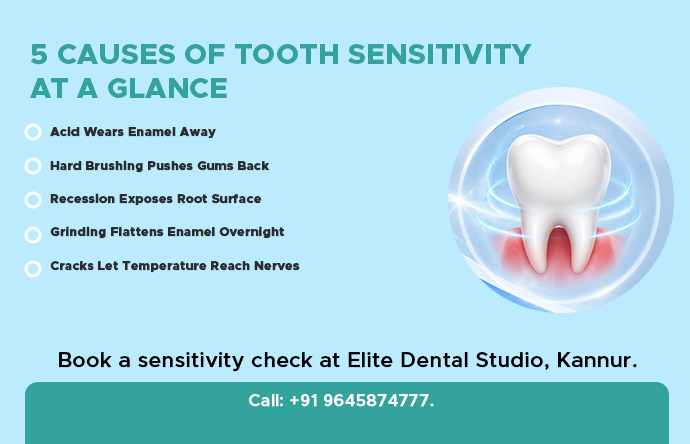
Five things cause most tooth sensitivity: enamel erosion from acidic food, hard brushing that pushes gums back, gum recession exposing the root, teeth grinding at night, and cracks or failing fillings. At Elite Dental Studio in Kannur, the dental team diagnoses which one is behind the pain before recommending anything.
This guide by our experts covers all 5 common causes of tooth sensitivity, and the specific signs that mean you should stop waiting and get it checked.
What Are the 5 Most Common Causes of Tooth Sensitivity?
Tooth sensitivity happens when dentin, the soft inner layer of your tooth, becomes exposed. Dentin is full of tiny microscopic channels called dentin tubules that run directly to the nerve at the centre of the tooth. Normally, enamel (the hard outer shell that covers each tooth) keeps dentin protected. When that enamel wears down, or when the gum tissue pulls back and exposes the root, those tubules open up.
Hot, cold, sweet or acidic things reach the nerve through them. That’s the sharp pain you feel. Here are the five most common reasons that it happens.
Cause 1: Enamel Erosion From Acidic Food and Drinks
Acidic food and drinks wear down enamel, the hard outer shell of each tooth, and once that layer is gone it doesn’t grow back. Every exposure softens enamel a little. Repeated daily, that softening becomes permanent wearing. The teeth underneath lose their protection.
Which everyday foods and drinks are the biggest culprits here?
- Multiple cups of tea or coffee
- Carbonated drinks
- Citrus fruits and lemon in food
- Tamarind in curries and chutneys
You don’t have to cut all of these. Rinsing with water after meals and not brushing immediately after acidic food reduces the damage. Where erosion has set in, a dentist in Kannur can apply fluoride varnish or bonding material.
Cause 2: Brushing Too Hard or With the Wrong Toothbrush
Vigorous brushing, stroke after stroke, wears enamel away and slowly pushes gum tissue down from the tooth. That’s a gum recession. The root underneath has no enamel, so once it’s exposed, sensitivity starts immediately.
How do you know if this is happening?
- Check the base of your front teeth for a slight notch or groove where the tooth meets gum.
- Sensitivity that hits mainly on the front surface of your lower teeth is another sign.
Switching to a soft-bristle brush and circular strokes usually stops progression.
Cause 3: Gum Recession Exposing the Root Surface
The crown of your tooth has enamel. The root doesn’t. When gum tissue pulls back and exposes that root surface, everything you eat and drink reaches it directly.
Why does recession happen?
- Hard brushing is one reason.
- Gum disease, which is a bacterial infection that gradually destroys gum tissue.
- Grinding puts long-term pressure on the gum line.
- Age thins gum tissue naturally.
- Some people just have thinner gums that recede more easily.
Sensitive toothpaste dulls the pain. It won’t stop the recession progressing. Gum disease needs direct treatment from the dental clinic, Talap.
Cause 4: Teeth Grinding During Sleep (Bruxism)
Most people are asleep when the damage is happening. That’s why grinding is so often missed. Bruxism generates far more force than ordinary chewing. And enamel disappears slowly.
Most people don’t connect the sensitivity to grinding because it builds gradually and there’s no obvious event to point to. Signs to look for on waking:
- Jaw that aches or feels tight in the morning
- Headaches starting at the temples
- Biting edges that look flatter or more chipped than expected
- A partner who’s mentioned grinding sounds
A custom night guard worn during sleep absorbs the force before it reaches the teeth. Pharmacy versions don’t fit properly and shift during the night. Custom-made guards by the best dental implant clinic in Kannur stay in place and distribute the load properly.
Cause 5: A Cracked Tooth or Old Filling With a Gap
Sometimes a tooth has a crack in it. The crack can be so small you can’t see it and your dentist can’t see it without an X-ray. But that tiny crack is enough. Every time you bite down, heat or cold gets in through that crack and hits the nerve directly.
Old fillings cause a similar problem. A filling that has been in your tooth for many years starts to loosen very slowly. Food, bacteria and temperature all get into that gap.
Both of these need a dentist to find and fix. Signs of a crack or failing filling:
- Sensitivity very specific to one tooth
- Pain on biting, not just heat or cold
- An old filling on that tooth
An X-ray and bite test at Elite Dental Studio usually identifies it. Small cracks and failing fillings can be repaired. Deeper cracks into the inner tissue may need root canal treatment to remove damaged pulp and seal the tooth.
When Should You See a Dentist in Kannur for Tooth Sensitivity?
A few teeth sensitivity cases can wait. However, a few need urgent intervention from a dentist in Kannur.
- Pain is sharp and specific to one tooth when biting
- Sensitivity getting worse over time
- Pain lingers more than 30 seconds after the trigger is gone
- Spontaneous pain with no obvious trigger
- Visible swelling around the sensitive tooth
These signs suggest the nerve or pulp is involved. The longer it goes, the more complex the fix. At Elite Dental Studio, the dental team identifies the exact cause with a clinical exam and X-ray where needed. And the tooth sensitivity treatment is matched to the cause.
Book a Tooth Sensitivity Check Up at Elite Dental Studio, Kannur.
Tooth sensitivity always has a cause. Finding it is the only way to fix it. Elite Dental Studio with famdent excellence in dentistry award, provides specialist-led care for sensitivity diagnosis, gum health, enamel assessment and restorative treatment.
Book a check-up at Elite Dental Studio, Kannur. Call our expert dentists at +91 9645874777.
Frequently Asked Questions
Can Tooth Sensitivity Go Away on Its Own?
Sometimes. If you stop the trigger, mild sensitivity can settle down. But a crack or a receding gum won’t heal by itself. Four weeks with no improvement means see a dentist.
Is Sensitive Toothpaste Safe to Use Every Day?
Safe to use, yes. But here’s the problem. It only hides the pain. Whatever is causing the sensitivity keeps going underneath. Don’t let it replace a check-up.
Why Does Only One Tooth Feel Sensitive?
One tooth means something is wrong with that specific tooth. Could be a crack, an old filling that’s loosening, or the gum pulling back just there. Worth getting that one tooth checked.
Can Tooth Sensitivity Mean Something Serious?
It can. Pain that stays after the hot or cold is gone, or pain when you bite down hard, means the nerve inside the tooth may be affected. That needs a dentist soon.
Have Dental Problem : Call us
CALICUT: +91 9745 072 555,
KOCHI: +91 9567 124 888
KANNUR: +91 9645874777
COIMBATORE: +91 9633694999
or make an Appointment
Take a smiling selfie and we'll Simulate your new smile See What Invisalign treatment could do for you!