





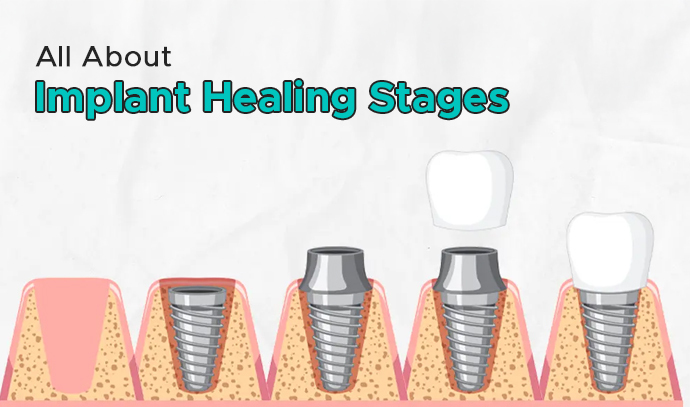
All About Implant Healing Stages
Dental implants are a long-term solution, but most patients worry about the healing time. They want to know what is normal after surgery, how healing progresses week by week, and when the final tooth will be placed. If you searched dental implant healing stages, you are likely planning treatment or you already had implant surgery.
Dental implant healing usually takes 3 to 6 months. During this time, the implant bonds with the jawbone, the gums heal, and the foundation becomes strong enough to support a permanent crown.
Implant healing follows a clear timeline. Your bone and gums repair step by step until the implant becomes stable and functional. At Elite Dental Studio, we guide patients who search for teeth implants near me and dental implants near me through every stage with planned follow-ups. This guide explains the healing stages, what you may feel at each phase, and how to protect your results.
What Are Implant Healing Stages?
Dental Implant healing stages are the natural healing-stages your body follows after implant surgery. The goal is osseointegration, where the implant bonds with bone through bone-integration and titanium-fusion. Healing happens in phases, and each phase builds on the previous one.
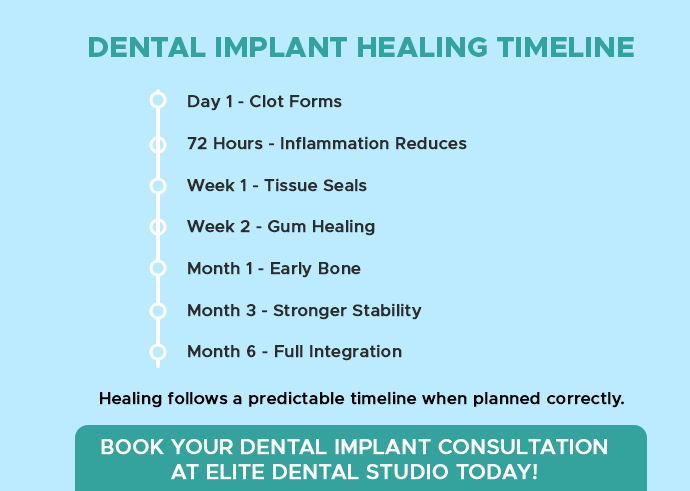
Implant Healing Timeline At A Glance
| Time | What Happens | What You Should Do |
|---|---|---|
| Day-1 | Blood clot forms, inflammation phase begins | Rest, ice compress, soft food |
| 72 Hours | Swelling reduces, early repair starts | Follow hygiene protocol, avoid smoking |
| Week-1 | Incision site seals, sutures may stay | Gentle cleaning, follow-up |
| Week-2 | Gingival healing improves, tissue closure | Saltwater rinse, chlorhexidine if advised |
| Month-1 | Early bone repair starts | Chew carefully, keep area clean |
| Month-3 | Stronger bone forms, stability increases | Attend recall visits, follow loading plan |
| Month-6 | Full integration and maturation | Permanent crown planning, long-term care |
This dental implant timeline helps patients looking for the best dental implant clinic in Kannur understand what to expect.
What Happens On Surgery Day?
On surgery-day, the implant is placed under a sterile-field. The dentist creates an incision-site and places the implant. A cover-screw or healing-collar may be used. The gums are closed with flap-closure using a tension-free approach. This reduces surgical-trauma.
The implant’s first strength is called primary-stability. It comes from how firmly the implant sits in the bone at placement.
What Happens In The First 72 Hours After Dental Implant?
The first 72-hours is the immediate-healing window. A blood-clot forms around the implant. This supports clot-stabilization. Mild swelling or hematoma can occur.
What helps most in this stage:
- ice-compress during the first day, as advised.
- soft-food and plenty of fluids.
- no-smoking, as smoking increases failure-risk.
- follow post-op-care instructions carefully.
This is also the phase where vascularization begins, meaning blood supply starts building around the implant-interface.
What Changes In Week 1 And Week 2 After Dental Implants?
During week-1 and week-2, soft tissues repair quickly.
You may notice:
- reduced swelling.
- improved comfort.
- better gum closure.
Inside the gums, fibroblast-activity supports repair. Gingival-healing progresses and epithelial-attachment forms. This creates a protective mucosal-seal.
Care tips for 2-weeks:
- follow hygiene-protocols.
- use chlorhexidine only if prescribed.
- use saltwater-rinse gently.
- do not disturb the area with hard brushing.
- attend follow-up appointments.
What Happens Between Month 1 And Month 3 After Dental Implants?
This is the key bone healing window. The body starts building woven-bone around the implant. Mineral-deposition increases as osteoblast-activity forms new bone. At the same time, osteoclast-resorption clears damaged bone.
This stage supports bone-density improvement and a stronger implant-interface.
Clinics may check stability using:
- resonance-frequency tools.
- ISQ-measurement for stability tracking.
- torque-value if required.
As healing progresses, stability shifts from primary-stability to secondary-stability. Secondary-stability comes from biological bonding, not mechanical grip.
What Happens Between Month 3 And Month 6 After Dental Implant?
Between month-3 and month-6, woven-bone changes into stronger lamellar-bone through bone-remodeling and bone-integration. This is the maturation-phase, where the implant moves toward full-integration.
If you needed bone-grafting, ridge-preservation, or sinus-augmentation, graft-remodeling continues during this time.
This stage is also where your dentist decides the safest loading-protocol:
- conventional-load or delayed-loading for many cases.
- immediate-load only for selected cases with excellent stability.
When Does The Crown Go On The Implant?
The crown is placed during the final-loading stage, after the implant is stable in bone. Treatment often includes a provisional-phase first, then a permanent-phase restoration.
At this stage, the dentist may do:
- abutment-connection.
- tissue-shaping to build a natural emergence-profile.
- support for sulcus-formation and papilla-regrowth.
A healthy mucosal-seal and good keratinized-gingiva help keep the implant clean and stable long term.
What Can Delay Healing Or Increase Risk?
Healing can slow down due to:
- Infection.
- micromotion or overload from chewing too early.
- poor oral hygiene.
- smoking.
- uncontrolled diabetes-impact.
- osteoporosis.
- medication-effects, including bisphosphonates.
Possible complications include mucositis, peri-implantitis, mobility, bone-resorption, early-failure, or late-failure.
How Do You Protect Implant Healing At Home?
These habits support a better success-rate:
- follow post-op-care exactly.
- stick to soft-food initially.
- avoid smoking completely.
- keep the area clean as per hygiene-protocol.
- attend recall-visits and follow-up reviews.
- follow the planned loading-protocol.
With proper planning and maintenance, many implant cases report a 95-percent long-term success-rate.
Why Choose Elite Dental Studio For Implants In Kannur?
If you are searching for teeth implants near me or dental implants near me, you want a clinic that manages the full healing journey, not just the surgery. At Elite Dental Studio, we plan each stage carefully and track healing so your implant stays stable and functional.
For patients seeking the best dental implant clinic in Kannur, our team focuses on predictable healing, safe loading decisions, and long-term-care.
Book Your Appointment at Elite Dental Studio, Kannur
Want a clear implant plan with timeline-based guidance? Visit Elite Dental Studio, Kannur to understand your implant healing stages and expected recovery.
Call +91 96458 74777 to book your appointment.
FAQs
How long do dental implants take to heal?
Many patients heal in 3 to 6 months. The exact time depends on bone health and loading plan.
Is swelling normal after implant surgery?
Yes, swelling can occur in the first few days and usually reduces within a week.
When can I chew normally?
Chewing returns gradually. Your dentist will guide you based on healing and stability.
What is osseointegration in simple words?
It is the process where the implant bonds with the jawbone and becomes stable.
How do I reduce implant failure risk?
Avoid smoking, keep strong oral hygiene, and attend follow-up and recall-visits.
Have Dental Problem : Call us
CALICUT: +91 9745 072 555,
KOCHI: +91 9567 124 888
KANNUR: +91 9645874777
COIMBATORE: +91 9633694999
or make an Appointment
Take a smiling selfie and we'll Simulate your new smile See What Invisalign treatment could do for you!