





Guide to Oral Hygiene for Kids: Daily Dental Care Routine Tips
“My child brushes every day.” We hear this a lot. And then we look inside the child’s mouth and find three or four teeth with early decay. So what went wrong?
Usually 20 seconds of brushing, no flossing, and a glass of Horlicks right before bed is not a good dental routine.
Childhood tooth decay is one of the most common health problems in children worldwide. Most of it is preventable, with the right fluoride, proper brushing, flossing and a few basic diet habits.
The pediatric dentistry specialists at Elite Dental Studio since 2020 work with children and parents every day across clinics in Calicut, Kochi, Coimbatore and Kannur.
This oral hygiene for kids: a parent’s guide to healthy smiles by our dental experts is what we actually tell parents at a first visit.
What Does a Daily Dental Routine for Kids Look Like?
One step in daily dental routine gets skipped, supervision drops off, or the timing is slightly off. Small gaps like these are where severe dental problems quietly build. Here’s the full routine, step by step.
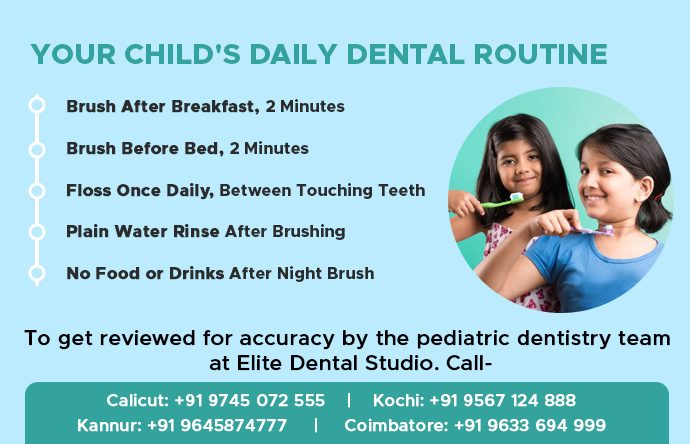
Step 1: Brush After Breakfast
Timing matters. Brush before breakfast, and whatever food your child eats sticks onto the teeth for hours without being cleared. Brushing after helps remove that food before the bacteria living in the mouth can start breaking it down.
How to Brush Correctly:
- Use a Soft-bristle toothbrush only. Soft means the bristles bend when pressed gently.
- Fluoride toothpaste from age 2. Fluoride is a natural mineral that makes tooth enamel harder. Stronger enamel means bacteria take longer to get through it.
- Two full minutes. Most children stop before that. Use a phone timer, a brushing app or just play a song.
- Brush the front of each tooth, the back and the flat chewing surface on top.
Step 2: Brush Before Bed
Night brushing matters more than morning brushing because during the day, your mouth produces saliva continuously. Saliva is the watery liquid in your mouth that naturally washes bacteria off your teeth as the day goes on. At night, saliva production slows down significantly. So whatever bacteria are on the teeth when your child goes to sleep stays there, undisturbed, for 7 to 8 hours.
Step 3: Floss Once a Day
Flossing is the step that most families skip completely. But a toothbrush physically cannot reach the gaps between teeth. Food and bacteria collect in those gaps and cause decay from the side of the tooth, often with no visible sign until the hole is already deep.
Start flossing when two teeth sit right next to each other. For most children, that’s around age 2 to 3.
If gums bleed a little in the first week of flossing, that’s normal. It means those gaps weren’t being cleaned before. Bleeding stops once flossing is regular.
Still bleeding after two weeks? Mention it to the kids dentist near me.
Step 4: Water Rinse
After brushing and flossing, a quick rinse with plain water clears anything loose from the mouth. Mouthwash isn’t needed for children under 6. Just water works fine.
Daily Dental Care for Each Age
The same four steps are followed at every age. What changes is how much help your child needs.
| Age | What to Do | Who’s Doing It |
|---|---|---|
| Under 2 | Wipe gums with a damp cloth after feeds.
Brush the first tooth with a small amount of toothpaste. |
Parents do everything. |
| 2 to 5 | Brush twice daily with a pea-sized amount of fluoride toothpaste.
Floss once daily. |
Parents do it. Child watches. |
| 6 to 9 | The child brushes while the parent watches.
The parent corrects technique and checks time. Floss together. |
The child tries. Parents correct. |
| 10 and above | The child runs the full routine. | Parent checks once a week. |
Essential Care and Prevention Tips for Kids’ Teeth
A wrong toothbrush is a real problem. Most parents keep the same toothbrush for too long, choose a size that’s too big, or pick one with hard bristles thinking it cleans better. It doesn’t. Here are 5 essential tips to follow for your kid’s teeth:
- Use soft bristles toothbrush with grain or pea size toothpaste.
- Replace the toothbrush every 3 months. Splayed, flattened bristles miss more surface than they clean.
- Let your child pick the colour or the character on the handle. A toothbrush they chose gets used .
- Always use fluoride toothpaste from age 2. Without fluoride, there’s no enamel protection.
- Do flossing right after the night brush when teeth-cleaning is already happening. Don’t try to introduce it as a separate thing.
Food That Helps Teeth and Food That Hurts
Every meal affects your child’s teeth, slowly, over months and years. It’s not about which food you eat. It’s about how often. Every time your child eats something sweet, the bacteria in the mouth produce acid for around 20 minutes. And over months, enamel breaks down. Here a list of food that helps and hurts your child’s dental health:
| Good for Teeth | Keep These Limited |
|---|---|
| Milk, curd, cheese | Fizzy drinks, packaged fruit juices |
| Apple, guava, carrot, cucumber | Sticky sweets, toffees, jaggery candy |
| Dal, eggs, fish, chicken | Biscuits and chips snacked on throughout the day |
| Plain water | Sweet drinks close to bedtime |
| Idli, dosa, rice (all fine) | Sugary breakfast cereals |
One specific habit to stop right now: Don’t let your child sleep with a bottle of milk, formula or juice. That liquid pools around teeth all night. The dentist calls it baby bottle tooth decay. Widespread early decay across the front teeth of young children comes from this habit.
When Should You Take Your Child to a Pediatric Dentist?
Most parents wait until a child is 3 or 4, or until something hurts. By then, decay that could have been caught and managed easily had developed more and became worse. Visit a pediatric dentist near me by age 1. Or when the first tooth appears. Whichever comes first.
Come In Earlier If You Notice Any of These
Don’t wait for the next scheduled check-up if your child has any of the following:
- A dark spot or brownish patch on a tooth
- Tooth pain or sensitivity to cold, sweet or hot food
- Gums that look swollen, red or bleed when brushing
- A tooth knocked out or chipped in a fall
- Teeth growing in crooked, crowded or in the wrong position
- A milk tooth that came out much earlier than expected
- A new tooth pushing through while the milk tooth is still sitting there
Book a Pediatric Dental Check-Up at Elite Dental Studio.
A pediatric dentist, also called a pedodontist, has completed a full dental degree and then done additional years of specialist training specifically for children’s dental care. That training covers how baby teeth develop and fall out, how adult teeth grow in to replace them, how the jaw changes from infancy through the teenage years, and how to manage care for children who are anxious, scared or resistant in the dental chair.
At Elite Dental Studio, children receive check-ups, fillings, fluoride application (a gel or varnish painted onto teeth to make enamel significantly stronger), dental sealants (thin protective coatings applied to the grooves on back teeth so food and bacteria can’t settle in), space maintainers (small appliances that hold a gap open when a milk tooth is lost early so the adult tooth has room to come in correctly), and habit correction when needed.
Every treatment plan at Elite Dental Studio is based on what your specific child’s teeth, age and habits actually need.
If you’re looking for a kids dentist near me, in Calicut, Kochi, Coimbatore or Kannur, call and book a pediatric check-up.
- Calicut: +91 9745 072 555
- Kochi: +91 9567 124 888
- Kannur: +91 9645874777
- Coimbatore: +91 9633 694 999
Frequently Asked Questions
At What Age Should a Child First See a Dentist?
By age 1 or when the first tooth appears, whichever comes first. It’s a check-up visit, not a treatment. The dentist checks that teeth are coming in correctly and shows parents how to clean a young child’s teeth at home. Children who start early are also much less anxious about dental visits as they grow.
How Much Toothpaste Is Safe for a Toddler?
Under 2 years: a smear, thin as a grain of rice. Age 2 to 6: pea-sized, one small blob. Always fluoride toothpaste from age 2. Teach your child to spit it out. At these amounts, swallowing a little isn’t dangerous. But spitting is the right habit to build.
When Should Kids Start Flossing?
When two teeth are sitting next to each other, usually around age 2 to 3. Parents do it for the child until around age 8 to 10. Child floss picks are the easiest tool for young children. String floss is hard to manage in a small mouth.
Are Fluoride Treatments Safe for Children?
Yes, when a dentist applies them in the right amount for the child’s age. According to the CDC, fluoride varnish can prevent around one-third of cavities in baby teeth. Your dentist checks your child’s cavity risk and decides whether a fluoride treatment is appropriate at each visit.
How Do I Get My Child to Brush Without a Battle?
Same time every night without negotiation. Let the child pick their own toothbrush. Play a two-minute song. For very young children, pretend you’re hunting “sugar bugs” hiding on the teeth. Brush at the same time your child brushes. Children copy what they see. No evening is perfect. A short brush done every night is far more useful than a thorough brush done twice a week.
Have Dental Problem : Call us
CALICUT: +91 9745 072 555,
KOCHI: +91 9567 124 888
KANNUR: +91 9645874777
COIMBATORE: +91 9633694999
or make an Appointment
Take a smiling selfie and we'll Simulate your new smile See What Invisalign treatment could do for you!